Independent UK medicine guidance
Mounjaro and gallbladder inflammation (cholecystitis)
Cholecystitis is an inflamed, and often infected, gallbladder. It is listed in the UK Mounjaro leaflet as an uncommon side effect in weight management, which puts it a long way behind gallstones in frequency, but it is the more dangerous of the two. A gallstone attack hurts and then passes. Cholecystitis hurts and keeps hurting, then adds a temperature. It is treated in hospital, not at home, and this guide is about recognising it early enough to get there.
Key facts
- Cholecystitis is an uncommon side effect of Mounjaro in weight management: up to 1 in 100 people (UK leaflet, revised August 2026).
- In the type 2 diabetes cardiovascular disease study it was common, up to 1 in 10. That figure comes from a different group of patients and does not apply to weight loss.
- Gallstones are a separate, more frequent problem (common in weight management). A stone that stays stuck is the usual trigger for cholecystitis, but most people with stones never get it.
- Pain under the right ribs that will not settle, joined by fever, shivering, repeated vomiting or yellowing of the skin or eyes, is an emergency: call 999 or go to A&E.
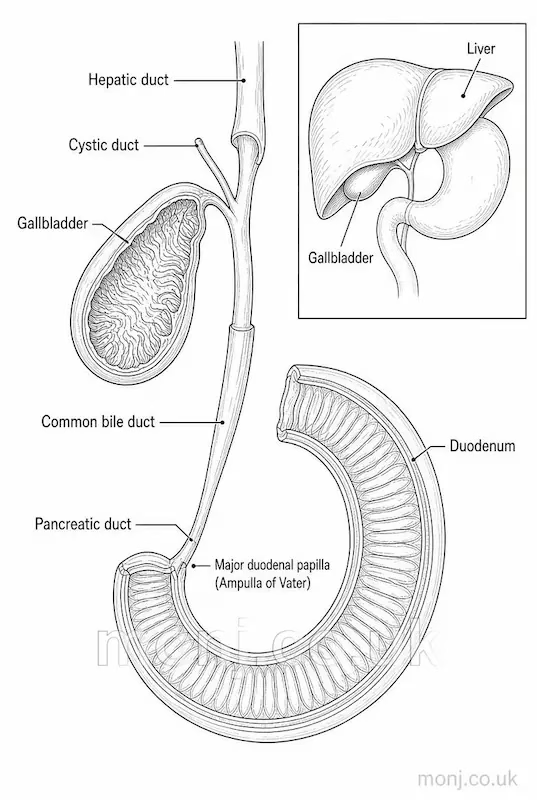
Gallstones and cholecystitis are not the same thing
The gallbladder is a small pouch tucked under the liver that stores bile and squeezes it out after a meal to help digest fat. Gallstones are hardened lumps of that bile. A large share of adults carry them without symptoms. Trouble starts when a stone moves and briefly blocks the cystic duct, the narrow tube in the diagram above. The gallbladder contracts against the blockage, the pain builds, and then, as the stone shifts or drops back, it fades. That is biliary colic, the ordinary gallstone attack.
Cholecystitis is what follows when the stone does not shift. Bile backs up, the wall of the gallbladder swells, and bacteria multiply in the trapped fluid. The pain stops behaving like an attack and starts behaving like an infection: it stays, it worsens when you breathe in or press under the ribs, and the body responds with fever and chills. It is usually treated with intravenous antibiotics and, in many cases, removal of the gallbladder.
How common is it on Mounjaro?
The two gallbladder problems sit in different frequency bands and they move in opposite directions between patient groups. Gallstones are common in weight management but uncommon in adults treated for type 2 diabetes alone. Cholecystitis is the reverse: uncommon in weight management, common in the cardiovascular disease study. For someone taking Mounjaro to lose weight, inflammation is the less likely of the two and the more serious. It is not separately listed for adults treated for type 2 diabetes in general.
Why weight-loss treatment raises gallbladder risk
Rapid weight loss on its own, with no medicine involved, is a long-established risk factor for gallstones. As fat stores are broken down the liver pushes more cholesterol into the bile, and at the same time the gallbladder empties less often because you are eating less and eating less fat. Concentrated bile sitting still is the recipe for stones. Tirzepatide adds to that by slowing the gut generally, which may reduce how often the gallbladder contracts. Those two effects together are the most likely reason gallstones are reported more often in weight-management studies than in diabetes studies.
Before starting treatment, and at any review, tell your prescriber if you have ever had gallstones, gallbladder inflammation, a gallbladder removed or pancreatitis. None of these automatically rules Mounjaro out, but the prescriber should know.
Symptoms of cholecystitis
- Severe, constant pain under the ribs on the right side that does not settle over hours
- Pain that spreads to the right shoulder or between the shoulder blades
- Pain that is sharper when you breathe in deeply or press the area
- A high temperature, shivering or sweats
- Feeling sick or repeatedly being sick
- Yellowing of the skin or the whites of the eyes, dark urine or pale stools
- Feeling generally very unwell, confused or weak
A single episode of right-sided pain that settles within an hour or two is more likely to be a gallstone attack, and still needs to be reported to your prescriber. Pain that is still there after 30 minutes should go to NHS 111. Pain that will not settle at all and is joined by any of the infection signs above should go to 999 or A&E.
What to do
Contact NHS 111 urgently if abdominal pain lasts longer than 30 minutes.
Call 999 or attend A&E for severe pain under the right ribs, particularly with fever or shivering, repeated vomiting, jaundice, confusion, collapse or severe weakness.
Do not try to ride out suspected gallbladder inflammation at home with painkillers, and do not assume that severe pain in the upper abdomen is an ordinary treatment side effect. Severe pain that bores through to the back can also be pancreatitis, which needs the same urgent assessment and which the leaflet says should prompt you to stop the medicine and get help.
Read the full guide to pancreatitis warning signs
Common questions
What is cholecystitis?
Cholecystitis is inflammation or infection of the gallbladder, most often caused by a gallstone lodging in the cystic duct and staying there. Unlike an ordinary gallstone attack, the pain does not settle and is joined by signs of infection such as fever or shivering. It normally needs hospital assessment, intravenous antibiotics and, frequently, surgery to remove the gallbladder.
How common is gallbladder inflammation on Mounjaro?
It is listed as uncommon in weight management, meaning up to 1 in 100 people. In the type 2 diabetes cardiovascular disease study reported in the UK leaflet revised in August 2026, it was common. Gallstones, a different problem, are common in weight management.
How do I tell gallbladder inflammation from a gallstone attack?
A gallstone attack builds, peaks and then eases, usually within a few hours. Cholecystitis pain persists, gets worse when you breathe in or press under the right ribs, and comes with a high temperature, shivering, repeated vomiting, jaundice or feeling generally very unwell. Persistent pain with a fever is the combination that needs emergency care rather than waiting.
Can I reduce the risk?
There is no guaranteed prevention. Rapid weight loss is a known risk factor for gallbladder problems, so a steady rate of loss, regular meals rather than long fasts, adequate fluid and a sensible amount of healthy fat in the diet all help the gallbladder keep emptying. Do not deliberately eat large quantities of fat to "flush" the gallbladder, which can trigger an attack if stones are already present.
Can I keep taking Mounjaro after cholecystitis?
That is a decision for the hospital team and your prescriber together. Many people have the gallbladder removed and later continue treatment, but the medicine is usually paused during an acute episode. Do not restart on your own after a hospital admission without confirming it with your prescriber.
How this page was checked. Frequency bands are taken from the Mounjaro KwikPen UK patient leaflet revised in August 2026 and section 4.8 of the Summary of Product Characteristics on the eMC (record 15481). Descriptions of gallstone disease and cholecystitis follow NHS guidance. Weight-management readers are the audience, so cardiovascular-study figures are always labelled. Monj is an independent price comparison service and does not prescribe or dispense medicines. Corrections go through our editorial and review policy.
Related guides
Sources: Mounjaro KwikPen UK Patient Information Leaflet, revised August 2026 (eMC) • Mounjaro Summary of Product Characteristics (eMC) • NHS: Gallstones • NHS: Acute cholecystitis
Explore other side effects
Tap a point on the body to jump to that symptom, or choose from the full list below. The pink marker shows where you are now.
© 2026 Medstack Ltd. Written and published by Monj (monj.co.uk). You are welcome to link to this page or quote a short extract with a credit and a link. Republishing the text, page structure, safety-routing design or price data, in whole or in part, including to train or ground an automated system, is not permitted without written permission. See our independence statement and editorial and review policy.
Sources referenced on this page
Linked from the text above:
- Mounjaro KwikPen UK Patient Information Leaflet, revised August 2026 (eMC) www.medicines.org.uk
- Mounjaro Summary of Product Characteristics (eMC) www.medicines.org.uk
- NHS: Gallstones www.nhs.uk
- NHS: Acute cholecystitis www.nhs.uk
Standing primary references for every Monj page:
- Mounjaro (tirzepatide) Summary of Product Characteristics and Patient Information Leaflet, electronic medicines compendium
- MHRA Drug Safety Update: GLP-1 receptor agonists
- NICE TA1026: tirzepatide for managing overweight and obesity
- General Pharmaceutical Council register of pharmacies
- MHRA Yellow Card scheme