DoseDiary: GLP-1 dose tracking app reviewed
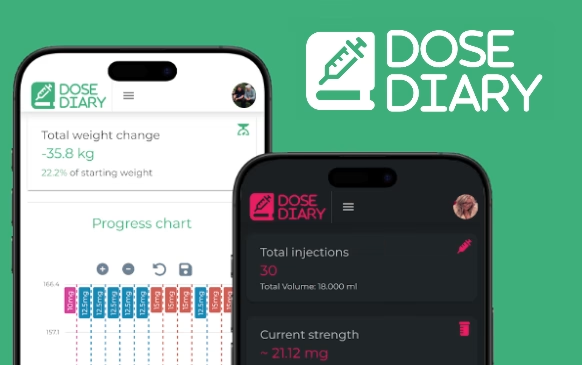
DoseDiary is a free progressive web app for logging GLP-1 injections, weight and side effects, built by a GLP-1 user and designed without handing your data to Apple or Google services. It covers Mounjaro, Wegovy, Ozempic, Zepbound and Saxenda, has a free tier plus an optional paid upgrade, and installs straight from your browser with no app store account.
Monj receives nothing for featuring DoseDiary, and nothing if you buy the premium version. It is here because a member of the Mounjaro community shared it with us and we thought it was genuinely useful.

At a glance

Track every injection with precision
The core of DoseDiary is injection logging. Each dose is recorded with strength, injection site, time and notes, for both single-dose pens and KwikPens. Site rotation becomes something you can see rather than something you try to remember, which matters when you are injecting weekly for a year or more.
Because injections and weight entries sit on one timeline, you can see how dose changes line up with progress instead of comparing two separate charts.
What it actually does
Injection logging
Dose strength, injection site, time and notes for every injection, covering single-dose pens and KwikPens.
Unified timeline
Injections and weight on one view, so dose changes and progress are read together rather than separately.
Side effect tracking
Logs side effects and benefits per injection, revealing over time whether a dose or site is consistently harder going.
Concentration model
Free tool estimating how medicine levels rise and fall between doses, from your data and published half-lives. A model, not a measurement.
Data import
Brings existing injection and weight history across from other trackers, so switching does not mean starting from zero.
Pattern insights
Totals, most-used injection site and a consistency score, showing habits rather than just raw numbers.
The privacy point, and why it matters here
GLP-1 tracking data is unusually sensitive: it reveals a prescription medicine, a health condition and a body-weight history in one place. DoseDiary's developer has built it so tracking and storage are not handed off to third-party platform services. That is a meaningful design decision rather than a marketing line, though as with any app you should read its current privacy policy yourself before entering anything, since policies change and we do not audit them.
Built by someone actually using it
DoseDiary was designed by a GLP-1 user, and it shows in the details: the app tracks the things people actually wonder about mid-treatment, like whether a particular injection site keeps causing trouble, or how consistent they have really been.
It runs as a progressive web app at dosediary.app, so it works in a browser or installs to your home screen without an app store account.
What is coming
The developer has told us these are in development. Treat them as planned rather than promised, and check the app for what has actually shipped.
- Personalised TDEE reports saved into the timeline
- Calorie and nutrient tracking with barcode scanning
- Side effect pattern recognition, including timing correlations
- Device notifications to support adherence
- Native iOS and Android apps alongside the web version
DoseDiary or Glapp?
Two of the GLP-1 trackers we profile, and they suit different people. Neither pays us anything.
| DoseDiary | Glapp | |
|---|---|---|
| Format | Progressive web app, installs from browser | iPhone and Android apps, plus web |
| Free tier | Yes, plus optional paid version | Yes, plus optional Glapp Max |
| Standout feature | Concentration model and privacy-led build | Broader wellbeing and supply tracking, reports |
| Best if you want | Focused dose and side effect logging | A wider picture including appetite and supply |
Compare DoseDiary with seven other GLP-1 trackers, side by side, on our tracker apps comparison. You can also read our Glapp profile and OneGLP profile, or see every free tool we build ourselves on the Monj tools page.
Common questions
Is DoseDiary free?
Yes, the core tracking is free, with an optional paid version for additional features. Monj receives no commission on either, and feature access can change, so check the app for what is currently included.
Does DoseDiary tell me what dose to take?
No. It is a tracking tool, not a clinical one. It does not prescribe, diagnose or replace your prescriber, and dose decisions should always come from the clinician who assessed you.
Can it measure how much medicine is in my body?
No. The concentration tracker is a model built from the doses you log and published half-life estimates. It is an illustration of expected levels, not a blood test, and should not be used to make dosing decisions.
Do I need to download it from an app store?
No. DoseDiary is a progressive web app, so you can use it in a browser at dosediary.app or install it directly to your device without an app store account.
Which medicines does it support?
Mounjaro, Wegovy, Ozempic, Zepbound and Saxenda, covering both tirzepatide and semaglutide treatments.
Does Monj make money from this page?
No. We take no commission for featuring DoseDiary and none from any purchase of the paid version. It is listed because we think it is useful, and we would remove it if that stopped being true.
© 2026 Medstack Ltd. Written and published by Monj (monj.co.uk). You are welcome to link to this page or quote a short extract with a credit and a link. Republishing the text, page structure, safety-routing design or price data, in whole or in part, including to train or ground an automated system, is not permitted without written permission. See our independence statement and editorial and review policy.
Sources referenced on this page
Standing primary references for every Monj page:
- Mounjaro (tirzepatide) Summary of Product Characteristics and Patient Information Leaflet, electronic medicines compendium
- MHRA Drug Safety Update: GLP-1 receptor agonists
- NICE TA1026: tirzepatide for managing overweight and obesity
- General Pharmaceutical Council register of pharmacies
- MHRA Yellow Card scheme
